Thwaites Glacier is one of the most closely watched parts of the West Antarctic Ice Sheet because its geometry makes it vulnerable to changes at the boundary where grounded ice begins to float. This transition, known as the grounding line, is difficult to observe directly but plays a central role in controlling glacier retreat and the transfer of ice into the ocean.
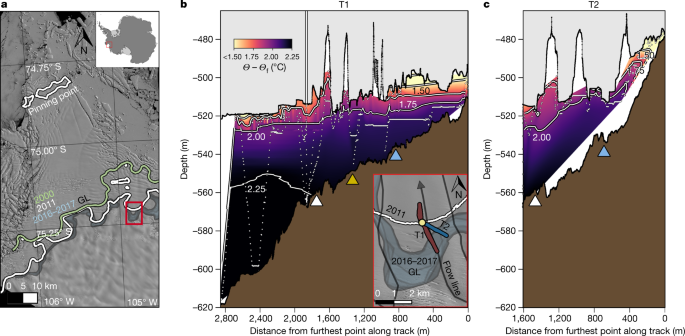
A 2023 Nature study led by B. E. Schmidt and colleagues provided unusually detailed observations of this hidden environment. The team deployed the Icefin underwater vehicle through a borehole in the Thwaites Eastern Ice Shelf and surveyed from the grounding zone out beneath the floating ice shelf. The vehicle recorded ocean conditions, mapped the ice base and seafloor, and returned images from a location that had previously been beyond the reach of conventional field observations.
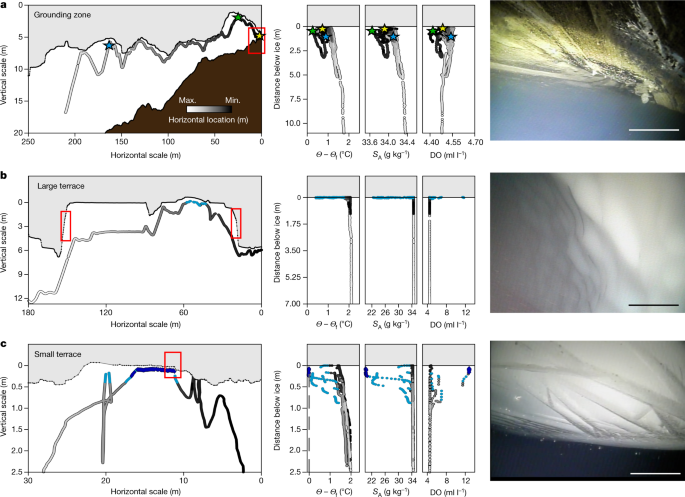
One of the clearest findings was that basal melting was not spatially uniform. Flat sections of the ice base could experience comparatively limited melting because a fresher, colder layer of meltwater helped insulate the ice from the warmer and saltier ocean water below. The geometry changed the story along inclined surfaces.
Near the grounding zone, the underside of the ice included steep-sided terraces, ridges and crevasses. Along these sloping surfaces, warm water could interact more efficiently with the ice. The observations showed stronger melting on the sides of terraces and inside crevasses, producing a complicated underside rather than a smooth, evenly melting surface.
That distinction matters for models. Large-scale ice-sheet simulations cannot resolve every metre-scale crevasse or terrace, so they use simplified descriptions of how ocean heat reaches the ice. Direct measurements from Icefin show that the location and shape of the ice-ocean interface can strongly influence where melting is concentrated. A glacier may therefore be weakening in structurally important places even when the average melt rate across a broad flat area appears modest.
The survey also documented warm water within the sub-ice cavity and evidence that the grounding line had retreated over the preceding decade. Thwaites is grounded below sea level across much of its catchment, which means retreat can expose thicker ice to ocean influence as the grounding zone moves inland. Understanding the small-scale melt processes is therefore part of the larger effort to improve projections of future ice loss and sea-level rise.
The study’s most important contribution is not a single melt-rate number. It is the demonstration that the pattern of melting matters. Ice geometry, ocean circulation, stratification and fractures interact at the grounding zone, creating local weak points that can influence the evolution of the ice shelf and the glacier behind it.
For polar researchers, these results reinforce the value of sending instruments directly beneath ice shelves. Satellite and airborne observations remain essential, but robotic measurements from the ice-ocean boundary provide the fine-scale evidence needed to test how well models represent processes that cannot be seen from above.